Flashlight vs. Headlamp: Which is Best for Outdoor Activities?
When planning outdoor adventures—whether hiking, camping, climbing, or night fishing—choosing the right hands-free lighting is critical. Two popular options dominate the market: flashlights and headlamps. Both serve the core purpose of illuminating the dark, but their design, functionality, and suitability for specific activities vary significantly. In this guide, we’ll compare flashlights and headlamps across key factors like portability, versatility, battery life, and activity-specific use cases to help you decide which is best for your next outdoor trip.
1. Design and Ergonomics: Hands-Free vs. Handheld Control
Headlamps are engineered for hands-free operation, with a strap that secures the light to your forehead. This design is a game-changer for activities requiring manual dexterity, such as setting up a tent, cooking over a campfire, or climbing steep terrain. The light follows your line of sight, ensuring you always illuminate what you’re looking at without adjusting a handheld device. Many models also feature adjustable headbands for comfort during long wear, making them ideal for multi-hour adventures like night hikes or trail running.
Flashlights, by contrast, require one hand to operate. While this limits mobility for tasks needing both hands, it offers precise control over the light beam. Flashlights often have larger, more powerful bulbs and reflectors, allowing users to focus the light on specific areas—perfect for scanning distant trails, signaling for help, or inspecting gear in detail. Their compact, cylindrical shape also makes them easy to stow in a pocket or backpack, though they can feel cumbersome if carried for extended periods.
2. Brightness and Beam Type: Focused Power vs. Wide Coverage
Brightness, measured in lumens, is a key consideration. Headlamps typically range from 50 to 1,000+ lumens, with most outdoor models averaging 200–500 lumens. They often offer multiple modes: a low-lumen “red light” to preserve night vision, a medium beam for close-up tasks, and a high beam for distance. Many also feature a “flood” beam, which spreads light broadly to illuminate a wide area—useful for navigating dense forests or campsites.
Flashlights, especially tactical or outdoor-specific models, can exceed 2,000 lumens, delivering intense, focused beams that reach hundreds of meters. Their beam types vary, including “spot” beams (narrow and long-range) for spotting wildlife or路标, and “flood” beams for wide-area lighting. This versatility makes flashlights superior for scenarios where raw brightness or long-distance visibility is critical, such as search-and-rescue missions or off-trail exploration.
3. Battery Life and Power Sources: Convenience vs. Longevity
Battery life depends on brightness settings and power source. Headlamps often use rechargeable lithium-ion batteries or AAA/AA batteries. Rechargeable models are eco-friendly and cost-effective long-term, though they require access to a power source. Some headlamps also offer hybrid power options, allowing you to swap in disposable batteries as a backup. On low settings, a headlamp might last 20+ hours, while high brightness could drain batteries in 1–2 hours.
Flashlights, especially larger models, tend to have longer battery life due to bigger batteries. Many use 18650 lithium-ion batteries, which offer high capacity and rechargeability. Some tactical flashlights even support USB-C charging, making them easy to power up via a portable charger on the go. However, smaller flashlights using AAA batteries may have shorter runtimes, similar to headlamps. For extended trips, flashlights with replaceable batteries are often preferred, as spares are lightweight and easy to pack.
4. Durability and Weather Resistance: Built for the Elements
Outdoor gear must withstand harsh conditions, and both flashlights and headlamps are built to endure. Most quality models are rated IPX4 (water-resistant to splashes) or higher, with IPX7 or IPX8 ratings indicating submersion resistance (up to 1 meter for 30 minutes). Headlamps often have rugged, lightweight casings (polycarbonate or aluminum) to handle bumps and drops, while their headbands are sweat-resistant for active use.
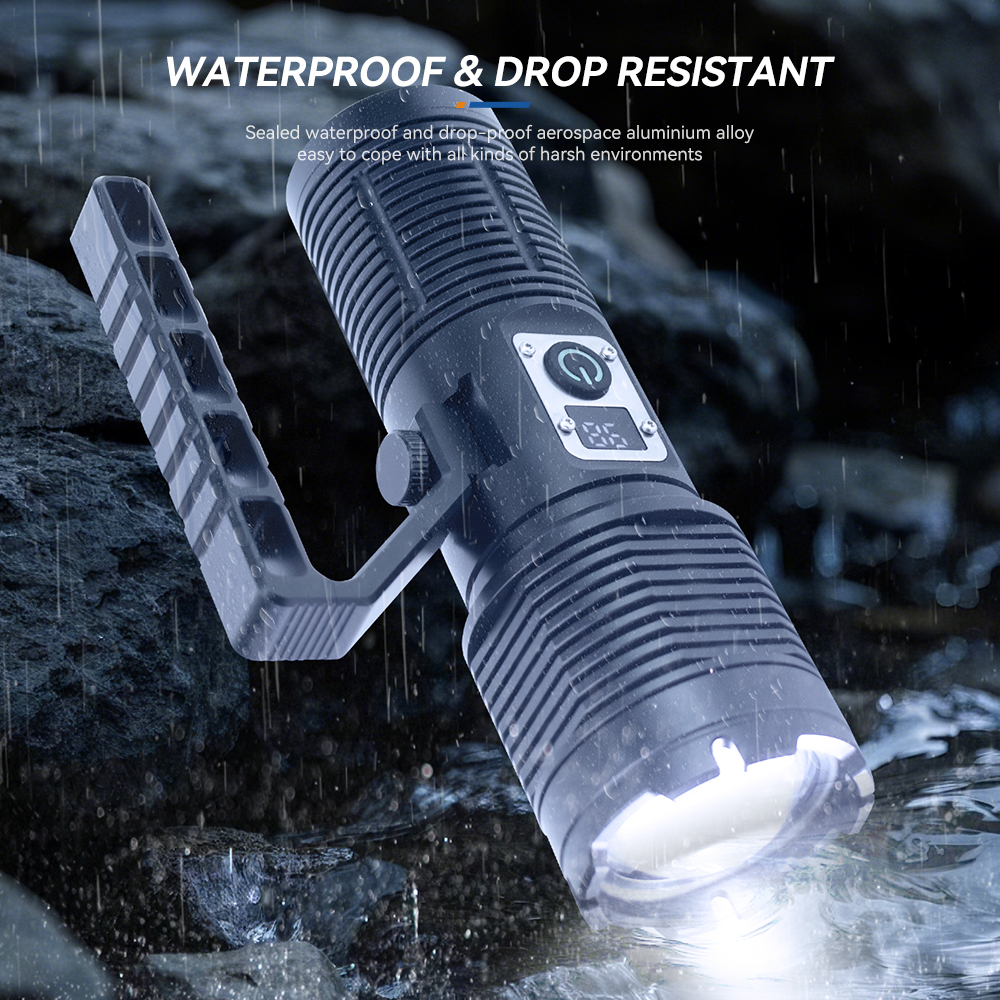
Flashlights, particularly those designed for camping or hiking, feature durable aluminum bodies that dissipate heat and resist corrosion. Some even include impact resistance (e.g., 1-meter drop protection) and waterproofing for river crossings or rainy weather. Their solid construction makes them reliable tools in extreme environments, from snowy mountains to humid jungles.
5. Activity-Specific Use Cases: Which to Choose When?
The “best” option depends on your activity:
- Hiking/Camping: Headlamps are the gold standard. They keep your hands free for trekking poles, map-reading, or cooking, and their flood beams light up trails and campsites effectively. A 300–500 lumen model with red light mode is ideal.
- Climbing/Mountaineering: Headlamps are essential for scaling rock faces or ice, where both hands are needed for gear and safety. Look for a lightweight, weatherproof model with a secure headband to prevent slipping.
- Night Fishing/Hunting: Flashlights excel here. A high-lumen spot beam can illuminate water surfaces or distant targets, while a red light mode avoids spooking fish or game. A handheld design also lets you direct light precisely where needed.
- Emergency Preparedness: Both have roles. A headlamp is indispensable for hands-free tasks during power outages or vehicle breakdowns, while a powerful flashlight can signal rescuers or light large areas.
- Trail Running: Headlamps are better for balance and mobility, with lightweight designs and adjustable brightness to match pace and terrain.
Conclusion: The Verdict
Headlamps and flashlights are not mutually exclusive—many outdoor enthusiasts carry both. However, if forced to choose:
- Choose a headlampfor hands-free activities, close-to-moderate range tasks, and multi-hour wear (hiking, camping, climbing).
- Choose a flashlightfor long-distance visibility, high-intensity tasks, and precise beam control (fishing, hunting, emergency signaling).
For most outdoor adventurers, a quality headlamp should be your primary light source, with a compact flashlight as a backup. Prioritize features like lumens, battery life, and weather resistance to match your specific needs, and you’ll never be left in the dark.
Unveiling the Multi-functional LED Pen Flashlight: A Must-Have for Everyday Convenience
Neck-Mounted Magnetic Work Light: A Perfect Blend of Innovation and Convenience